

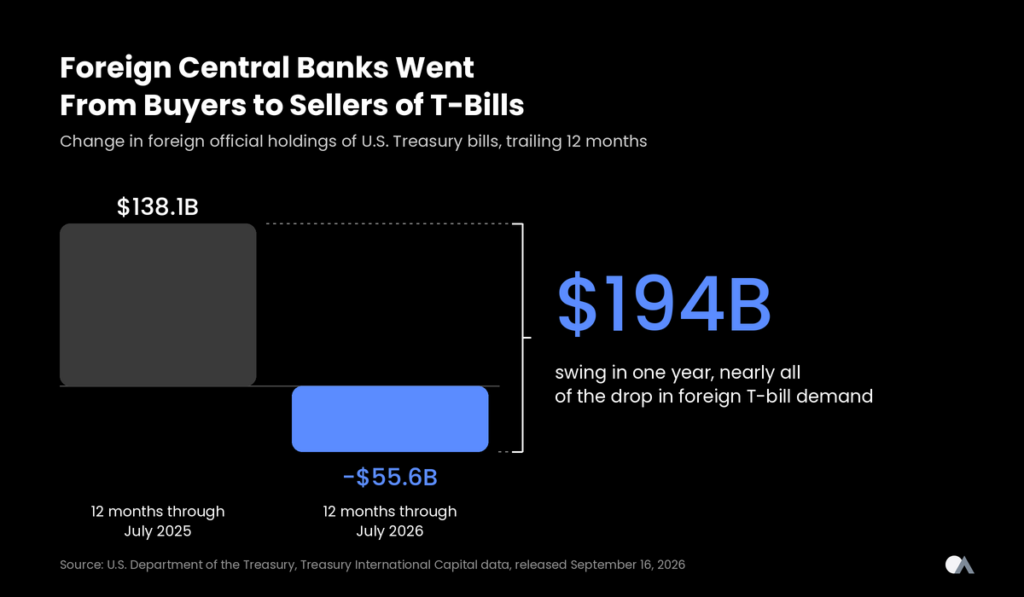
Foreign central banks and governments cut their U.S. Treasury bill holdings by $55.6 billion in the twelve months through July 2026. A year earlier, they added $138.1 billion. That swing of roughly $194 billion accounts for nearly all of the 80% drop in foreign T-bill demand.
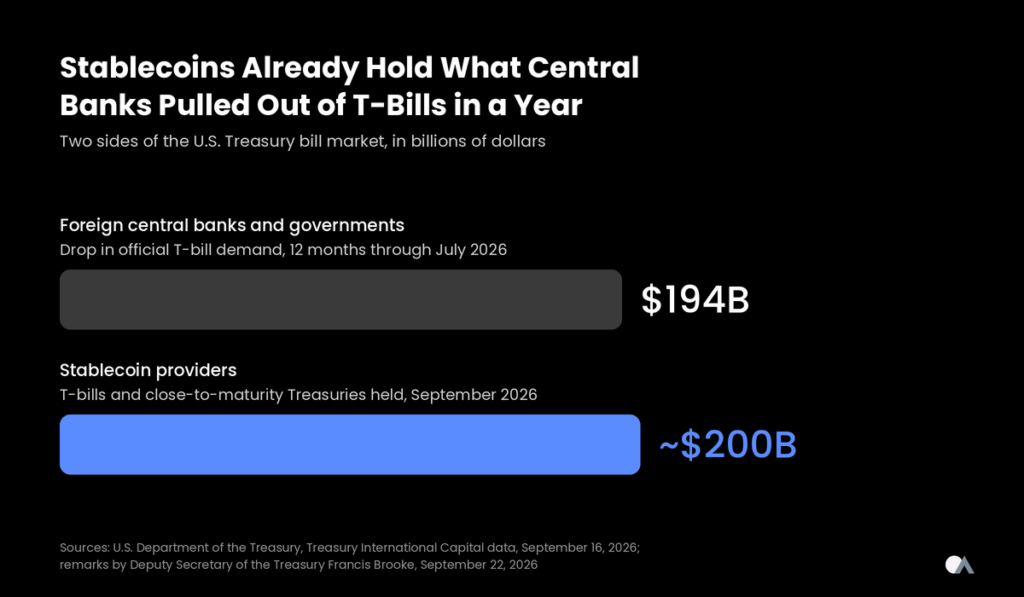
A newer buyer’s position is already on the same scale as the demand that disappeared. Stablecoin providers own nearly $200 billion of Treasury bills and other close-to-maturity Treasuries, according to the Deputy Secretary of the Treasury, who told the market in September that their growth matters more than what they hold today.
Scaled on regulated infrastructure, stablecoins become a global distribution channel for U.S. government debt.
Treasury International Capital data tracks how much U.S. debt foreign residents buy and sell, and has long served as a gauge of global appetite for dollar reserves.
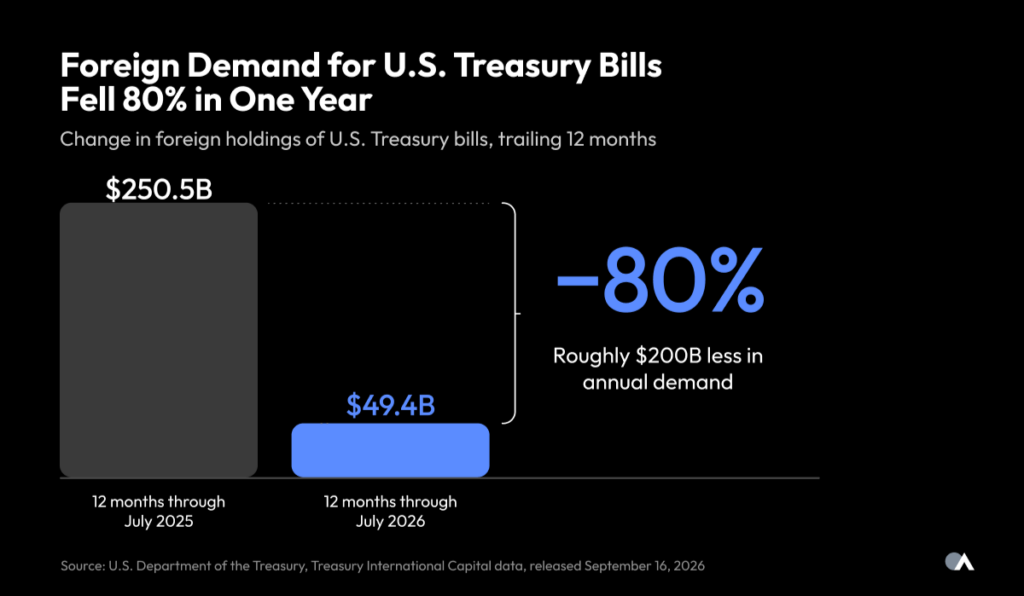
Net foreign purchases of T-bills fell from $250.5 billion to $49.4 billion, and almost all of the drop came from the official side. Private buyers held close to flat, at $105.0 billion versus $112.4 billion a year earlier. Treasury’s advisory committee noted in February 2026 that foreign central banks keep adding gold, and suggested geopolitical risk may be driving reserve diversification. July extended the trend: official investors sold a net $6.3 billion while private buyers kept adding.
Treasury now lists stablecoin providers among the structural sources of demand it monitors, alongside banks, money market funds and the Federal Reserve. A Bank for International Settlements working paper, updated through March 2026, finds that stablecoins bought nearly $35 billion of T-bills in 2025, on par with the largest government money market funds, and that by December their assets exceeded the short-term U.S. securities held by major foreign investors.
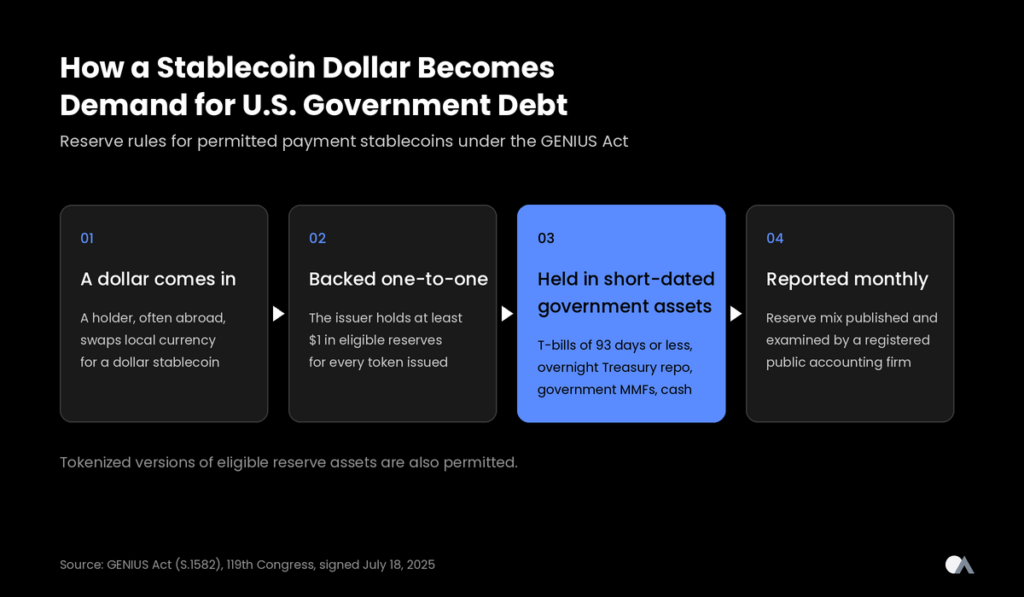
The mechanism is written into law. Under the GENIUS Act, signed in July 2025, a permitted payment stablecoin must be backed at least one-to-one by eligible reserves: Treasury bills maturing in 93 days or less, overnight Treasury repo, government money market funds, cash, and tokenized versions of most of those assets. Issuers publish the reserve mix every month, examined by a registered public accounting firm. Each new dollar of issuance adds demand for short-dated government debt, and when it comes from holders outside the U.S., it is new demand for the dollar itself.
Treasury’s advisory committee has been tracking the shift. In February 2026 it reported that two of the largest issuers had added $70 billion in T-bills since 2022, with bills making up 53% of their reserves. In April 2025 it cited projections of stablecoin supply reaching $2 trillion by 2028 under a supportive regulatory framework, which would require more than $1 trillion in bills. The effect already shows up in prices: the BIS estimates that a $3.5 billion stablecoin inflow lowers three-month bill yields by up to 4 basis points within ten days.
Central bank demand moves with reserve strategy and geopolitics. Stablecoin demand moves with a different decision: a person or business, often outside the U.S. banking system, choosing to hold dollars instead of a local currency. The GENIUS Act turns that choice into a legal reserve requirement, and monthly reporting makes it visible.
It also lands where Treasury needs it. Net bill supply rose by more than $550 billion in July and August 2026, and money market funds absorbed about 85% of it, including stablecoin reserves held through those funds.
Treasury has named the condition for the next leg of growth: final rules under the GENIUS Act. Those rules make reserves a monthly reporting obligation and allow them to be held in tokenized form, putting Treasury bills and government money market funds on the same rails as the stablecoins they back. Treasury’s advisory committee adds that tokenized collateral could widen the use of Treasuries further.
This is the layer OpenAssets builds. Its issuance platform sets backing, supply, and mint and burn rules for regulated stablecoins and tokenized funds. Its compliance layer limits holdings to verified wallets, and its token contracts let the issuer block a sanctioned wallet from sending tokens and burn its balance. OpenAgent, an SEC-registered transfer agent built natively for tokenized securities, keeps the ownership record and reports to regulators. OTAS, the open standard under the Linux Foundation Decentralized Trust to which OpenAssets is a founding contributor, keeps those records consistent across issuers and chains. Together, they let a regulated dollar token reach holders outside the United States with every holder verified and every reserve reported.
USDT shows the channel already operating at scale. It is the world’s largest stablecoin, with $184.6 billion in circulation as of June 30, 2026, more than 60% of the stablecoin market, serving markets largely outside the United States. Its supply grew during the second quarter even as the overall stablecoin market contracted.
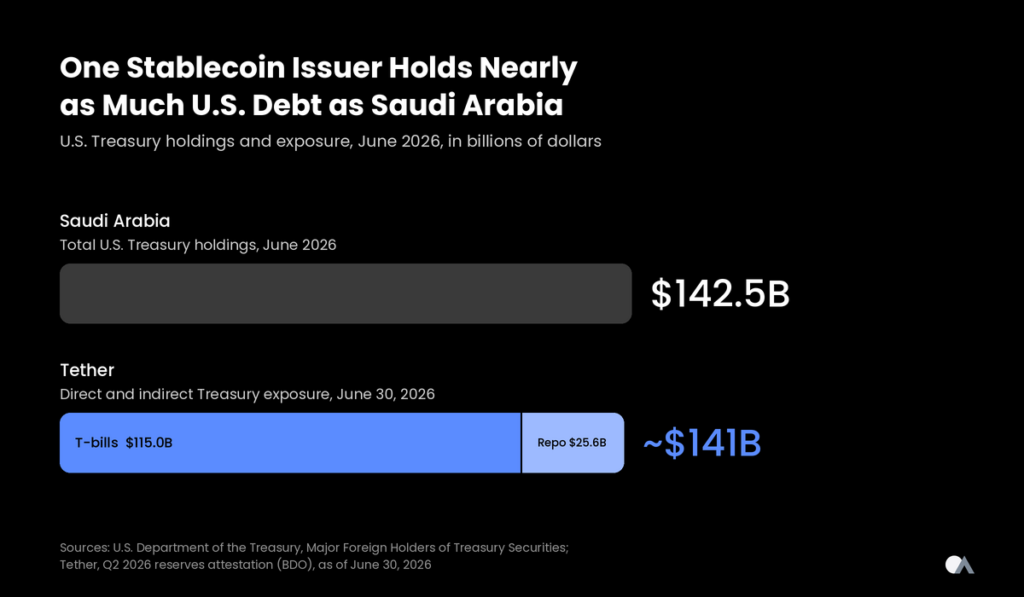
Those holders are, in effect, financing U.S. government debt. At the end of June, Tether held $115 billion in Treasury bills and $25.6 billion in reverse repo, for about $141 billion in direct and indirect Treasury exposure, roughly three-quarters of its reserves. That is comparable to the $142.5 billion in Treasuries Saudi Arabia held the same month, according to Treasury’s own data. The rest of Tether’s reserves include gold, Bitcoin and secured loans, and an independent accounting firm attests to them every quarter.
The economics run through the Treasury market too. Tether reported $1.5 billion in net operating profit for the second quarter, driven primarily by interest on its Treasury bills and repo. In the same quarter, markdowns on gold and Bitcoin cut its excess reserves from $8.23 billion to $4.11 billion, while the Treasury book kept producing income. At this scale, a stablecoin issuer is a Treasury market participant in its own right.
Foreign official demand for Treasury bills now depends on decisions made in other capitals. Stablecoin demand depends on how many people choose dollars, and under the GENIUS Act it can be verified every month, reserve by reserve. OpenAssets builds the infrastructure that makes that verification routine. The larger this channel grows, the more of U.S. short-term financing will run on it.
Disclaimer:
This article is for informational purposes only and does not constitute legal, tax, regulatory, or investment advice. Figures are drawn from public Treasury data, issuer disclosures, and third-party research as cited; readers should consult primary sources and qualified professionals before relying on this information for decision-making.